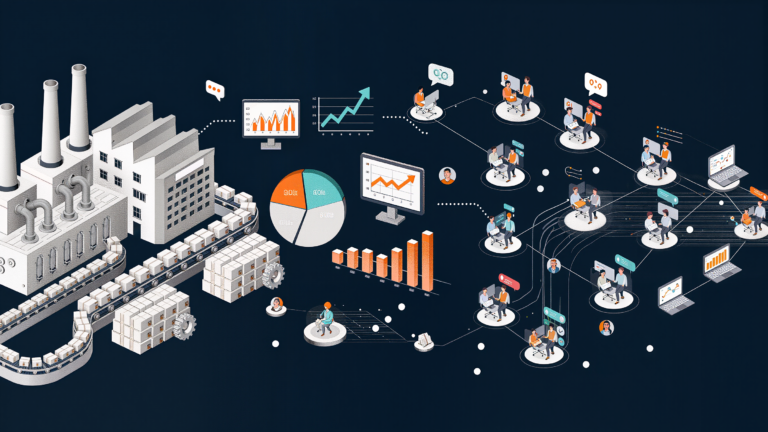
Walk into the boardroom of almost any Fortune 500 company today, and you will hear the language of the modern marketing era. Executives speak fluently about being “customer-obsessed,” “market-driven,” and “user-centric.” Yet, if you ignore the rhetoric and examine the actual allocation of capital, the metrics on the executive dashboard, and the daily decisions of middle management, a starkly different reality emerges. The vast majority of resources are dedicated to supply chain efficiencies, aggressive sales conversion targets, and the rapid deployment of product features that stem from internal engineering capabilities rather than verified market demand.
This presents a fundamental paradox in modern business practice: while the intellectual framework of management has evolved toward a customer orientation, the operational reality of the firm remains deeply anchored in the logic of production and sales. We witness software companies building sophisticated architectures that solve no urgent user problem, then blaming the sales force for inadequate execution. We see manufacturing firms optimizing unit economics for products that are steadily losing relevance. This is not merely an execution failure; it is a profound cognitive mismatch. Managers are attempting to navigate a market-oriented world using the mental models of the industrial age.
The Hidden Problem: The Gravity of the Measurable
The evolution of marketing thought—from the production era, to the product era, to the sales era, and finally to the marketing era—is standard curriculum in any business school. However, treating this evolution merely as a historical timeline is a systematic error. These eras do not represent a linear progression of history that we have safely left behind; rather, they represent competing cognitive frameworks that coexist within the modern organization.
The hidden problem is that the gravitational pull of the production and sales mentalities is exceedingly difficult to escape. The reason is rooted in organizational psychology and the economics of information. Production and sales are inherently internal, quantitative, and easily measured. A manager can accurately calculate manufacturing throughput, engineering velocity, cost of goods sold, and daily sales volumes. By contrast, true market orientation requires measuring the external, the qualitative, and the ambiguous: unmet customer friction, shifting behavioral contexts, and psychological value.
Because organizations are wired to optimize what they can easily measure, managers systematically default to production-era logic. When faced with missing revenue targets, the immediate organizational reflex is rarely to question the fundamental utility of the offering (a market orientation). Instead, the reflex is to demand more output from the sales team (a sales orientation), add more features to the offering (a product orientation), or cut costs to preserve margins (a production orientation). These assumptions lead to systematic decision errors because they misdiagnose the root cause of the firm’s stagnation, treating a failure of market alignment as a failure of operational efficiency.
Understanding the Mechanism: A Hierarchy of Cognitive Models
To understand why this regression occurs, we must dissect the underlying causal logic of each “era” not as history, but as active decision-making mechanisms. Each orientation represents a distinct way of answering the firm’s most critical question: How do we generate value?
The Production Mechanism: The Logic of Scarcity The production concept operates on the assumption that consumers will favor products that are available and highly affordable. The causal logic is entirely internal: focus on high production efficiency, low costs, and mass distribution. This mental model thrives in supply-constrained environments. However, when deployed in mature, demand-constrained markets, it creates a dangerous cognitive bias where executives view scale and efficiency as the primary drivers of strategy, ignoring the fact that efficiently producing something nobody wants is the ultimate waste of capital.
The Product Mechanism: The Endowment Effect As markets saturate, the organizational mindset often shifts to the product concept—the belief that consumers will favor products that offer the most quality, performance, or innovative features. The decision mechanism here is driven by internal engineering and R&D capability: “We have the technology to build a better mousetrap, therefore we must build it.” This leads directly to what Theodore Levitt famously termed “marketing myopia.” The cognitive trap is a form of the endowment effect and confirmation bias; creators become so enamored with their own technical achievements that they lose sight of the underlying problem the customer is actually trying to solve.
The Sales Mechanism: The Logic of Liquidation When the “better mousetrap” fails to sell itself, organizations default to the sales concept. The underlying assumption is that consumers exhibit buying inertia or resistance and must be aggressively coaxed into purchasing. The mechanism shifts from creating value to liquidating inventory. The organizational dynamics here become highly aggressive, heavily incentivizing short-term persuasion tactics, discounts, and asymmetric information. The fatal flaw in this logic is that it treats the customer as a passive receptacle for the firm’s output, optimizing for the single transaction rather than the lifetime value of the relationship.
The Market Mechanism: Reversing the Causal Arrow The true marketing concept—customer orientation—requires a complete reversal of the previous three mechanisms. Instead of a “push” logic (starting with the factory or the codebase and pushing outward to the market), it requires a “pull” logic. The causal arrow reverses: it starts with a well-defined market, focuses on customer needs, coordinates all activities affecting customers, and produces profit by creating customer satisfaction. The intellectual rigor here lies in understanding that the firm does not sell products; it sells the resolution of a customer’s problem.
Strategic Implications
Understanding this cognitive evolution is not an academic exercise; it has profound strategic implications for how modern organizations are structured, how they allocate capital, and how leaders evaluate performance.
For executives, recognizing the persistence of production-era logic requires a fundamental restructuring of organizational incentives. If a CEO demands customer-centricity but exclusively rewards division heads based on short-term volume metrics and cost reduction, the organization will invariably revert to a sales and production orientation. True market orientation requires executive leadership to fund the rigorous, often slow process of market discovery before greenlighting the rapid, measurable process of product development.
For managers and analysts, this framework changes what constitutes valid data. Financial and operational metrics are trailing indicators of past production and sales efficiency. Managers must develop leading indicators of market alignment. Analysts evaluating a firm’s strategic health must look beyond the balance sheet to assess whether the company’s R&D expenditure is driven by genuine market insights or by internal capability traps—the tendency to keep doing what the firm is already good at, regardless of market demand.
For entrepreneurs, the shift from product to market orientation is often the difference between scaling a business and burning through venture capital. Many startups fail because they are fundamentally product-oriented; they build elegant solutions in search of a problem. A strategically sound entrepreneurial venture begins with a granular understanding of a severe market friction point, and only then designs the organizational capabilities required to solve it.
Rethinking the Way We Decide
To operationalize a true market orientation, business leaders must adopt new mental models that disrupt their default cognitive biases. The goal is to move away from inside-out decision-making toward outside-in strategic reasoning.
The most vital shift in managerial reasoning is the inversion of the traditional value chain. The classical, production-era mental model follows a linear sequence: Assets → Inputs → Offerings → Customers. In this model, the firm assesses its current assets and capabilities, creates an offering, and then tasks the marketing department with finding customers to buy it.
Leaders must explicitly train their teams to reverse this heuristic. The market-oriented mental model flows in the exact opposite direction: Customers → Needs → Capabilities → Assets.
When making strategic decisions, the first question should never be, “How can we leverage our existing manufacturing capacity or codebase?” That is a production-era starting point. The rigorous analytical starting point is, “What specific job is the customer struggling to get done under current market conditions?” Only after defining that unfulfilled need does the organization work backward to determine what capabilities and assets must be acquired, built, or partnered to deliver that exact solution.
Furthermore, leaders must foster a culture of intellectual honesty regarding failure. When a product launch underperforms, the default organizational reaction is often to increase the marketing budget—a symptom of the sales orientation. Better strategic reasoning demands a different diagnostic approach. Leaders must be willing to accept that poor sales are rarely a failure of persuasion; they are almost always a symptom of poor market orientation. Rethinking how we decide means viewing poor financial performance not as a reason to push harder, but as a signal to listen closer.
Conclusion
The evolution of marketing thought is ultimately an evolution in strategic judgment. It charts the painful, ongoing transition from inward-looking corporate narcissism to outward-looking market empathy. Mastering this transition is the hallmark of sophisticated managerial reasoning. It requires leaders to embrace the ambiguity of human behavior and to resist the comforting, quantifiable certainty of factory floors and lines of code.
Decision-making under uncertainty requires a firm anchor, and the only sustainable anchor in a dynamic economy is the continuously evolving needs of the customer. However, achieving strict alignment with today’s customer is only the first layer of the challenge. As organizations perfect their ability to satisfy explicit, currently articulated market demands, they must immediately confront an even deeper strategic paradox: how to allocate resources between serving the customer of today and anticipating the unarticulated, invisible needs of the customer of tomorrow.
Further Reading & Academic Foundations
Christensen, C. M., Hall, T., Dillon, K., & Duncan, D. S. (2016). Competing against luck: The story of innovation and customer choice. HarperBusiness.
Day, G. S., & Moorman, C. (2010). Strategy from the outside in: Profiting from customer value. McGraw-Hill Education.
Kahneman, D. (2011). Thinking, fast and slow. Farrar, Straus and Giroux.
Kahneman, D., Knetsch, J. L., & Thaler, R. H. (1990). Experimental tests of the endowment effect and the Coase theorem. Journal of Political Economy, 98(6), 1325–1348.
Kotler, P., & Keller, K. L. (2015). Marketing management (15th ed.). Pearson.
Levitt, T. (1960). Marketing myopia. Harvard Business Review, 38(4), 45–56.